Tag Archive for: prefabricated bridge

Bridging Safety and Sustainability: The Environmental Benefits of Prefabricated Bridges

As infrastructure owners look for faster and more efficient ways to replace aging bridges, project success is increasingly measured by more than cost and schedule. Agencies, engineers, contractors, and communities are also evaluating how bridge construction affects natural resources, traffic, surrounding neighborhoods, and the people performing the work.

Prefabricated bridge construction helps address these priorities by moving much of the fabrication process away from the project site and into a controlled manufacturing environment. Bridge components can be engineered, fabricated, inspected, and prepared for installation before they arrive in the field.

This approach can reduce material waste, limit onsite emissions and disturbances, shorten work-zone exposure, and create more predictable working conditions. Together, these advantages make prefabrication an increasingly valuable tool for delivering safer and more sustainable infrastructure.

What Is a Prefabricated Bridge?

A prefabricated bridge is constructed using components that are manufactured away from the final installation site. Depending on the project, these components may include steel trusses, girders, bridge decks, panels, modular units, or nearly complete bridge systems.

Once fabrication is complete, the components are transported to the project location and assembled or installed according to a coordinated erection plan.

The Federal Highway Administration refers to these components as Prefabricated Bridge Elements and Systems, or PBES. According to the FHWA, PBES components are built offsite or near the bridge site and are designed to reduce onsite construction time and the mobility impacts associated with conventional bridge construction.

The prefabricated bridge market continues to develop as infrastructure owners seek faster delivery, improved quality control, shorter road closures, and reduced onsite labor exposure. Industry analysis also points to growing interest in reusable modular systems, corrosion-resistant materials, safer installation methods, and lower-disruption construction.

How Does Prefabrication Make Bridge Construction More Sustainable?

Prefabrication can improve the environmental performance of bridge construction by reducing waste, shortening onsite activity, limiting community disruption, and supporting more efficient use of materials.

The FHWA identifies reduced environmental impact as one of the potential benefits of Prefabricated Bridge Elements and Systems. Because components are manufactured offsite and installed more quickly, project teams may reduce the physical and operational footprint of construction at the bridge site.

1. More Precise Fabrication Can Reduce Construction Waste

Traditional field construction often requires materials to be measured, cut, fitted, adjusted, and stored under changing jobsite conditions. Weather, limited workspace, design changes, handling damage, and inaccurate field measurements can contribute to excess material use or rework.

In a fabrication facility, bridge components are produced using detailed engineering specifications, repeatable processes, specialized equipment, and established quality-control procedures. Materials can be ordered and processed more precisely, while offcuts and scrap can be separated and managed within an established recycling system.

At U.S. Bridge, the company’s integrated engineering and fabrication process uses computer-controlled equipment, detailed design information, and established quality-assurance procedures to help ensure that approved bridge specifications are carried through to fabrication.

This does not mean prefabrication eliminates waste. Every bridge project still requires careful planning, transportation, installation, and material management. However, moving major fabrication activities into a controlled environment can make material use more predictable and reduce the likelihood that errors will be discovered only after components reach the field.

Reducing construction and demolition waste is an important sustainability objective because roads, bridges, and other civil engineering projects generate heavy material streams that may include steel, concrete, asphalt, wood, plastics, and other products.

The U.S. Environmental Protection Agency recommends source reduction, reuse, recycling, and more efficient material management to conserve resources and reduce the amount of construction material sent to landfills.

2. Shorter Construction Durations Can Lower the Project’s Carbon Impact

A bridge project’s carbon impact extends beyond the materials contained in the finished structure. It can also include emissions associated with:

  • Heavy equipment operating at the site
  • Temporary construction facilities
  • Material deliveries and repeated mobilization
  • Worker transportation
  • Traffic congestion and vehicle idling
  • Detours created by extended closures
  • Rework caused by field errors or weather-related damage

Prefabrication concentrates more work within the manufacturing phase and reduces the amount of time needed for onsite construction and assembly.

When installation can be completed within a shorter window, equipment may spend fewer days operating at the site. Crews may require fewer repeated mobilizations, and communities may experience shorter periods of traffic control, detours, and congestion.

The exact emissions savings will vary by bridge type, transportation distance, installation method, equipment requirements, and traffic conditions. For this reason, prefabrication should not automatically be described as a zero-carbon solution. Its environmental value comes from reducing avoidable onsite activity and giving project teams greater control over the construction sequence.

The FHWA notes that accelerated bridge construction using PBES can reduce traffic impacts, onsite construction time, and weather-related delays. It can also minimize environmental impacts, utility relocations, and changes to existing roadway alignments.

How Can Prefabricated Bridges Protect Sensitive Project Sites?

Bridge construction frequently occurs near rivers, wetlands, forests, residential areas, parks, and other sensitive environments. The longer a project remains active at the site, the greater the potential for noise, dust, erosion, sediment disturbance, equipment traffic, and temporary impacts on surrounding land.

Prefabrication cannot remove every environmental risk, but it can reduce the amount of fabrication and assembly work performed in these locations.

Potential benefits include:

  • Fewer days of heavy onsite activity
  • Reduced need for large material-staging areas
  • Less exposure of unfinished materials to weather
  • Shorter periods of noise and equipment operation
  • More controlled construction sequencing
  • Greater flexibility around environmental restrictions

According to the FHWA’s overview of PBES benefits, moving heavy construction activities into factories can help limit disruption to environmentally sensitive areas such as wetlands. Shorter construction durations can also reduce the overall environmental footprint of a project.

By completing more work before components arrive at the site, project teams can focus the field phase on coordinated delivery, erection, connections, inspections, and finishing activities.

How Does Prefabrication Improve Worker Safety?

Safety is one of the most important advantages associated with prefabricated bridge construction.

Bridge jobsites can expose workers to moving traffic, uneven terrain, changing weather, work at height, heavy equipment, crane operations, and limited working space. These hazards cannot be eliminated entirely, especially during transportation and erection. However, prefabrication can reduce the amount of time crews spend working within these conditions.

Less Time Working Near Active Traffic

Construction along active highways creates risks for both workers and motorists. By shortening the duration of lane restrictions and road closures, prefabricated bridge construction can reduce exposure to work-zone traffic.

The FHWA identifies enhanced worker and motorist safety as an important benefit of Prefabricated Bridge Elements and Systems. Tasks that would ordinarily be completed within a work zone can instead be performed offsite before the bridge elements are delivered and erected.

Fewer onsite construction activities can mean fewer workers exposed to passing vehicles, traffic-control operations, and changing work-zone conditions.

More Work Performed in a Controlled Environment

A manufacturing facility offers conditions that are difficult to reproduce consistently at a bridge site. Work areas can be designed around repeatable processes, established lifting procedures, permanent equipment, designated material-storage locations, and routine inspections.

Fabrication also provides greater protection from rain, wind, extreme temperatures, and other weather conditions that can affect both productivity and quality. The FHWA notes that prefabricated elements are typically constructed in a climate-controlled environment, meaning weather primarily affects the portion of the work completed onsite.

Controlled conditions do not remove the need for strong safety programs. Manufacturing work can still involve welding, material handling, repetitive motion, lifting, and ergonomic risks.

The Occupational Safety and Health Administration recommends designing prefabrication workstations and tools to limit forceful exertion, repetitive motions, awkward postures, contact stress, and other ergonomic hazards.

The goal is not simply to transfer risk from the field to the facility. It is to manage work in an environment where hazards can be identified, standardized, and controlled more consistently.

Reduced Field Rework

Rework can introduce additional lifts, cutting, welding, grinding, equipment operation, and exposure hours. It may also force crews to solve problems within confined or elevated areas.

Detailed bridge engineering, factory fabrication, and quality inspections can help identify potential fit-up or fabrication issues before components reach the bridge site. This supports a safer and more orderly erection process.

The field should be the place where a well-coordinated installation plan is executed—not where major fabrication discrepancies are discovered for the first time.

Does Prefabrication Reduce Community Disruption?

Yes. Sustainability includes more than material selection and emissions. It also includes the effect a project has on the people and businesses surrounding it.

Long bridge closures can affect commuting times, emergency services, school transportation, freight movement, local businesses, and access to essential services. Even when a bridge remains partially open, extended construction can create congestion, noise, and uncertainty.

Prefabricated components can help shorten the most disruptive portion of the project. The bridge may still require site preparation, foundation work, transportation planning, and final connections, but the duration of intensive onsite construction can often be reduced.

Industry research identifies shorter closures, improved schedule certainty, rapid installation, reduced field assembly time, and lower onsite labor exposure as important drivers behind prefabricated bridge adoption.

For the surrounding community, completing the work more quickly can mean:

  • Shorter detours
  • Fewer days of traffic congestion
  • Less noise and dust
  • Reduced disruption to businesses
  • Faster restoration of transportation access
  • More predictable project schedules

The FHWA also reports that prefabricated systems can provide greater convenience for travelers by reducing the duration of bridge and roadway closures and minimizing construction-related traffic delays.

Can Steel Prefabricated Bridges Support Circular Construction?

Steel bridge systems can support circular construction goals because steel components can be recycled, and certain modular bridge systems may be relocated, reconfigured, or reused when their engineering and condition allow.

The ability to reuse a bridge system depends on its original design, project requirements, service history, connections, structural condition, and applicable standards. Not every bridge is intended to be disassembled or moved.

However, designing infrastructure with future adaptability in mind can help owners consider value across the full lifecycle rather than focusing exclusively on the initial installation.

Current prefabricated bridge market trends show increasing interest in recyclable materials, reusable modular systems, lifecycle performance, reduced maintenance, and carbon-conscious material choices.

U.S. Bridge offers several prefabricated steel bridge designs for different applications, including the Liberty Bridge, which is manufactured from prefabricated panels and assembled into modules. Its modular configuration can support permanent, emergency, and inventory-based bridge applications.

Is Every Prefabricated Bridge Automatically Sustainable?

No construction method is automatically sustainable in every application.

A prefabricated bridge must still be engineered for its specific location, loading, service environment, transportation route, erection method, maintenance needs, and expected lifespan.

Project teams should evaluate:

  • Material sourcing
  • Fabrication efficiency
  • Transportation distance
  • Component weight and shipping requirements
  • Crane and installation needs
  • Site-access limitations
  • Coating and corrosion-protection systems
  • Inspection and maintenance requirements
  • Expected service life
  • Potential reuse or recyclability
  • Traffic and environmental impacts

A bridge manufactured efficiently but transported through an impractical logistics plan may not provide the desired environmental benefits. Similarly, rapid installation is only successful when safety, quality, and long-term performance remain central to the process.

The strongest results come from considering sustainability early—during engineering, material selection, fabrication planning, transportation planning, and erection sequencing.

Safety, Sustainability, and Quality Are Connected

The environmental and safety benefits of prefabrication are closely related.

Accurate fabrication can reduce waste and rework. Reduced rework can lower equipment use and worker exposure. Shorter onsite schedules can decrease traffic disruption and work-zone risk. Controlled manufacturing conditions can improve consistency, supporting durability and long-term performance.

A durable bridge that performs as intended for many years can also reduce the need for premature repairs, replacement materials, additional closures, and repeated construction activity.

That is why sustainability should not be treated as a separate feature added at the end of a bridge project. It is the result of coordinated decisions made throughout the bridge lifecycle.

Building Better Infrastructure Through Prefabrication

As communities invest in resilient transportation networks, bridge owners are looking for solutions that balance speed, safety, environmental responsibility, and long-term value.

Prefabricated steel bridges offer a practical way to advance those priorities. By completing more work in a controlled manufacturing environment, project teams can improve material efficiency, reduce onsite disturbances, shorten worker exposure, and provide communities with a more predictable construction experience.

At U.S. Bridge, engineering, manufacturing, logistics, and field coordination are integrated to help deliver bridge systems that meet the needs of each project. From initial design through fabrication and installation support, careful planning helps turn the benefits of prefabrication into safer, more efficient, and more sustainable infrastructure.

Learn more about why prefabricated bridges are powering the future of U.S. infrastructure, explore our selection of prefabricated steel bridge designs, or start building your bridge today.

_________


Frequently Asked Questions

What are the environmental benefits of prefabricated bridges?

Prefabricated bridges can reduce onsite material waste, equipment activity, traffic delays, construction noise, and disturbance to sensitive areas. Their shorter field schedules may also reduce emissions associated with prolonged work zones, repeated mobilizations, and vehicle idling.

How does prefabrication reduce construction waste?

Bridge components are manufactured using detailed drawings, repeatable processes, and controlled material handling. This can improve cutting accuracy, simplify scrap collection, and reduce errors or weather damage that could result in discarded materials.

Are prefabricated bridges safer to construct?

Prefabrication can improve safety by moving more work away from active traffic and unpredictable field conditions. It also shortens the time crews spend in work zones. Transportation, lifting, erection, welding, and manufacturing hazards must still be managed through detailed planning and established safety practices.

Do prefabricated bridges reduce carbon emissions?

They can reduce some project-related emissions by shortening onsite construction, limiting equipment operating time, reducing traffic congestion, and decreasing repeated mobilizations. Actual carbon savings depend on material choices, transportation distances, erection requirements, and the complete project lifecycle.

Are steel bridges sustainable?

Steel bridges can support sustainable infrastructure goals through durability, efficient fabrication, recyclability, and, in some modular applications, potential reuse or relocation. Sustainability depends on responsible design, sourcing, corrosion protection, maintenance, and lifecycle planning.

Why are prefabricated bridges becoming more popular?

Infrastructure owners are increasingly using prefabricated bridges to reduce closures, improve schedule predictability, limit onsite labor exposure, support rapid installation, and address bridge replacement needs more efficiently. Industry forecasts indicate continued growth in prefabricated bridge adoption as agencies prioritize resilience, safety, and lower-disruption construction.
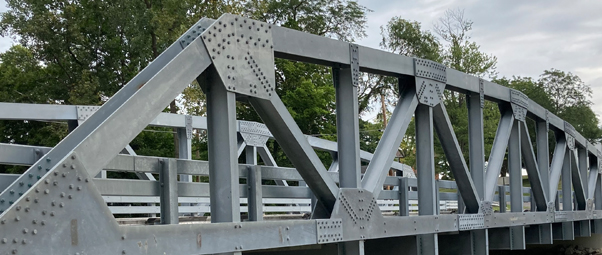
In 2020, U.S. Bridge answered the call when Miami County asked for a new bridge at Croft Mill Road. The existing 107-foot bridge was in dire need of a replacement. Apart from the 40-year-old bridge being well beyond the point of repair, the bridge faced a 25% reduced load capacity and a narrow width of 15′-6″.

Besides the typical challenges of hydraulic adequacy and road profile constraints, the crossing at Croft Mill Road crossing spans across Greenville Creek, which is part of Ohio’s State Scenic River. Because of this, the Croft Mill Road crossing has a history and setting that creates an attractive and noticeable structure which deemed it as a public investment. Therefore, it was our intention to keep it this way.

Widening and Galvanizing

When replacing the crossing at Croft Mill Road, we knew we had to modernize the bridge’s width. The width of the old structure was much too slim for contemporary standards. As a result, we increased the width from 15′-6″ to 28 feet.

Along with widening the path, the new bridge features hot-dipped galvanized steel trusses. Galvanization bonds zinc to steel, resulting in a much more rugged and reliable bridge. Galvanizing also eliminates corrosion for up to 100 years. We are so confident in our galvanizing process that we provide a 35-year warranty on our galvanized steel beam bridge.

Choosing the Right Bridge

Miami County considered several structure types for the project. Prestressed concrete box beams or I-beams were considered, but at the time of construction, manufacturing limits eliminated the possibility of utilizing prestressed concrete box beams.

In addition to manufacturing constraints, the depth of the beams required for a span length would greatly affect the structure’s waterway adequacy. Another option was to raise the roadway significantly, but either choice proved unfeasible. This is why Miami County decided to pursue the galvanized truss option for replacement.

Preserving the Property

Overall, the goal was not only to increase the span length over the former bridge but also to limit the impacts on Greenville Creek and the surrounding property on the north side of the bridge. When visiting the site today, it’s almost impossible to notice the changes to the property because of how well the bridge fits into the surrounding area. We are proud of this accomplishment but even more proud of keeping Ohio’s rich history alive and untarnished.

Build To Last with U.S. Bridge

U.S. Bridge has been building bridges that withstand time for over 80 years. It’s our guarantee to provide the highest level of quality steel in our bridges. Contact us today to get started on your next project, or get a headstart on the process using our exclusive BridgeScope tool today.

alt=""

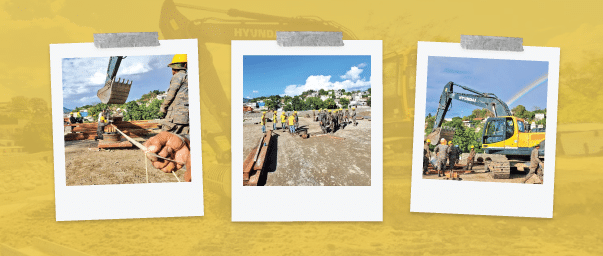
In November of 2020, a pair of tropical storms, Iota and Eta, swept through Central America. These two storms were the most powerful storms to hit Central America in decades. So when a bridge collapsed in the rural city of Gualán, Zacapa, Guatemala, they knew they needed to find a sturdy replacement bridge and fast. That’s why they relied on a trusted brand to provide a high-quality Liberty Bridge.

Security After the Storms

Tropical storms Iota and Eta created flooding, mudflows, and dozens of catastrophic landslides across Central America. Many cities and infrastructures were destroyed, including the collapse of a bridge in the rural city of Gualán, Zacapa. The community needed a new bridge quickly to help with recovery and keep the communities connected. And we’re proud to say that they chose us to supply them with our durable and fast-installing Liberty Bridge.

Engineers from the Guatemalan Military installed the prefabricated bridge into place. The Ministry of Communications, Infrastructure, and Housing worked alongside the Municipality of Gualán to supply the necessary input to complete the project’s installation. The project’s success improved the lives of over 1,900 families within the community.

Not Just for Emergencies

Our Liberty Bridge is a truss-style design that is adaptable to many different elevations. Its rigorous durability and quick installation make it ideal for emergencies. However, just like our other bridges, its high-quality materials make the bridge long-lasting.

Our lightweight design gives you a wide range of flexibility but one of its major advantages is its prefabricated panels. These panels are easy to transport and easy, perfect for quick construction. Not to mention, the sleek design of the bridge offers an esthetically pleasing structure.

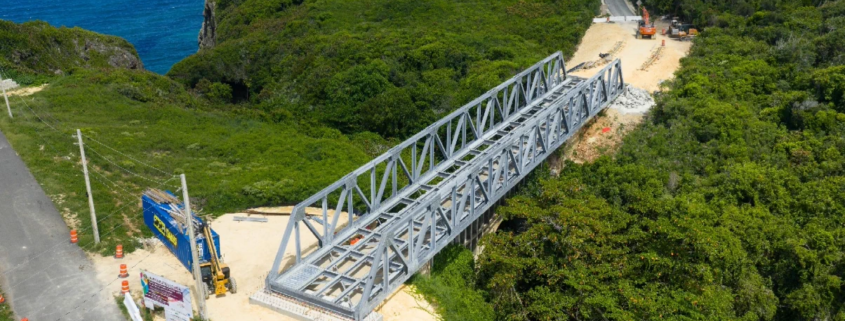
Four years ago, Hurricane Maria battered most of Puerto Rico. This led U.S. Bridge to supply five separate Liberty Bridges throughout the island as quickly as possible. The completion of Puerto Rico’s five Liberty Bridges took a mere six weeks. Because of this quick turnaround, residents and communities on the island were able to reconnect in record time.

Seeing those results, it’s no surprise that they relied on us and our materials in Guatemala.

High-Quality Steel Shipped Internationally

U.S. Bridge produces high-quality versatile bridge designs to meet the needs of any situation. Our bridges are proudly produced in Ohio and can be shipped out internationally to help any community in need. U.S. Bridge is grateful for the opportunity to bring communities closer.

As an AISC-recognized supplier, we guarantee the best quality of steel in every project. Contact us for a free quote or use our exclusive Bridgescope tool!

At the start of any construction project, you have to ask what materials and method would best accomplish your goal. You’ve probably come across modular bridge construction and you’ve wondered what is it and should you consider it.

We’ve created a brief introduction to modular construction and its benefits to bridge design.

Modular Construction

Modular construction is any construction that is built in a controlled environment, typically a factory, and later installed on-site. The popularity of modular construction is increasingly rising due to its various advantages such as speed, flexibility, and customization.

Modular construction, sometimes known as prefabricated construction, is built with the same materials and similar methods as regular construction, but often comes with additional features unique to prefabrication. For example, since they are manufactured in a controlled environment modular construction has the advantage of ensured quality.

In addition, because it takes place simultaneously in a factory and on-site, modular construction can be completed in half the time of traditional construction. This rapid construction phase and versatility allow them to be used in various situations.

The combination of ensured quality, speed, and flexibility is why modular construction is often considered a durable and efficient option for builders.

The Benefits of Modular Bridges

Modular bridges are relatively modern and thus have many misconceptions. Despite popular belief, modular bridges do not require the use of already premade sections of limited sizing and options. The great thing about modular bridges is their customization and flexibility.

Every modular bridge is specifically designed custom to your project and design. This customization process makes it a preferred and sometimes even, required option for some bridge projects.

Not to mention, since most of the bridge is premade in a safe environment, the likelihood of weather delays or traffic disruption is significantly decreased. Additionally, it provides workers with safer and more comfortable working conditions. Thus modular bridges offer easy and effective project management. It’s an ideal option for any construction project with time or budget constraints.

Build your Next Bridge with U.S. Bridge

As an industry leader in bridge manufacturing and engineering, we’ve built solutions that can be utilized for any bridge project. We’ve developed Bridge Kits, a DIY solution for accelerated bridge construction that is engineered, designed, manufactured, and galvanized per AISC certifications.

We work with environmentally friendly materials to build strong, long-lasting bridges. Coupled with extensive experience, our team designs, and manufactures high-quality bridges custom to your project.

We’ve been engineering bridges for decades. If you’d like to know more about our Bridge Kits and accelerated bridge construction, please contact us for a free quote or use our exclusive bridge design tool Bridge Scope today.

Prefabricated Bridge

Many decisions are made when it comes to new bridge construction, one of those is the choice of a prefabricated bridge or built on-site construction. How do you know which one works best for your project? Here’s a guide to help you understand prefabricated bridges and when to use them.

What are Prefabricated Bridges?

Prefabricated bridges are built in a separate location, then transported to the construction site for installation. They are a popular form of accelerated bridge construction with their own benefits and considerations.

With U.S. Bridge, our Bridge Kits are a solution for the time-constrained and budget-focused bridge construction projects. We engineer, design, manufacture, and galvanize every piece of the bridge. After each part is ready, we send it to the construction site along with a dedicated member of the U.S. Bridge team to oversee the construction.

Why Use a Prefabricated Bridge?

The first benefit of prefabricated bridges is their quick assembly rate. Unlike building on-site, prefabricated bridges are essentially already made just in separate pieces that are later connected on site. Another advantage is that they are less susceptible to weather delays due to their short assembly time, which decreases the disruption to traffic.

Moreover, prefabricated construction is more energy-efficient and environmentally sustainable in comparison to building on site. As construction takes place within a factory, extra materials are recycled in-house for the next project.

Despite popular belief, modular construction is more affordable and allows flexibility to construction teams. The financial savings not only stem from a shorter construction time but it is also due to the discounts prefabricated construction receives from bulk orders.

In addition, as each component of the bridge is built in a controlled environment, our team ensures the quality of the materials. Furthermore, in-door construction provides a safer setting by decreasing workers’ exposure to open traffic.

When to Use Prefabricated Bridges

The flexibility of prefabricated bridges allows them to be used in various situations. Accelerated construction requires fewer trucks of equipment and materials which is beneficial for remote locations or uneven topography. For instance, prefabricated bridges are often used in emergency situations due to the ease of assembling and disassembling them.

Additionally, prefabricated bridges will benefit your project if your team doesn’t have much experience in bridge construction, as U.S. Bridge sends a member of our team to oversee the construction.

Shorter Construction Time

Due to its accelerated assembly rate, prefabricated bridges are ideal for projects that require temporary construction or projects that are concerned with traffic delays. This is especially the case with U.S. Bridge, as our team can ensure the bridge is built correctly from the start.

If on-site construction time needs to be shorter, then a prefabricated bridge is the best choice. Because of assistance from U.S. Bridge, the bridge construction can be much more efficient and smooth.

Materials for Prefabricated Bridges

Steel and concrete are perhaps the most popular form of prefabricated bridges. The material and the environment of the bridge dictates the design of the bridge. Other components of your bridge project will determine if prefabricated bridges are right for you.

U.S. Bridge: Experts in Prefabricated Bridge Construction

With over 80 years in the bridge construction industry, we’ve engineered and built over 10,000 bridges worldwide. Prefabricated bridge constructions make up a good portion of those constructions. Here at U.S. Bridge, we are dedicated to our customers and the construction of their bridges.

All of our prefabricated Bridge Kits are custom-designed, come with our hands-on expertise in bridge construction, and are built to fit your bridge project needs and budget. Contact us today and let’s talk about how we can make your bridge project a long-lasting success.

The U.S. Liberty Bridge soars above the competition. With their rigidity and adaptability to various elevations, these bridges are designed to be containerized and quick to construct in the event of an emergency. Also, they are a preferred permanent bridge. After Hurricane Maria’s devastation in Puerto Rico, U.S. Bridge built Liberty Bridges in five communities across the island. U.S. Bridge’s Liberty Series Bridges are the ideal solution to any project.

Bolted Permanent Bridges Surpass Pinned Temporary Bridges

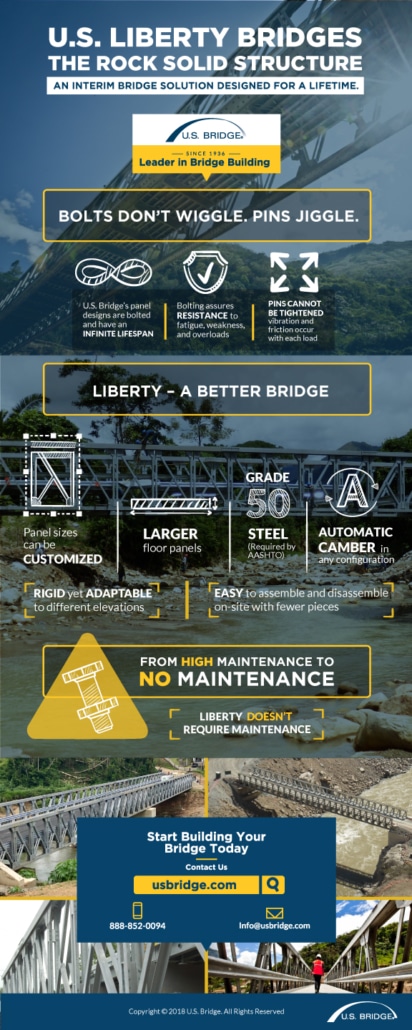
U.S. Liberty Bridges have numerous advantages, but one of the main reasons is their prefabricated panels. Each panel is designed with a bolting system that has an infinite lifespan. In addition, bolting assures resistance to fatigue, weakness, and overloads. This system increases the sustainability of the bridge as a whole and eliminates the need for maintenance. Contrarily, the incorporation of pins into alternative type structures leads to vibration and friction with each load, and over time, more maintenance and monitoring. With its customizable panel sizes, the U.S. Liberty Bridge also spans up to 200 feet. And its larger floor panels give it the ability to support one or multiple lanes of traffic. All these features make the Liberty Bridge the preferred choice for emergency situations.

Begin Your Project With U.S. Bridge

U.S. Bridge has over 80 years of history and experience in the engineering, manufacturing and installation of steel bridges. We help communities create safe and longer-lasting bridges globally. For more information about our bridges and services contact us today.

U.S. Liberty Bridges Infographic


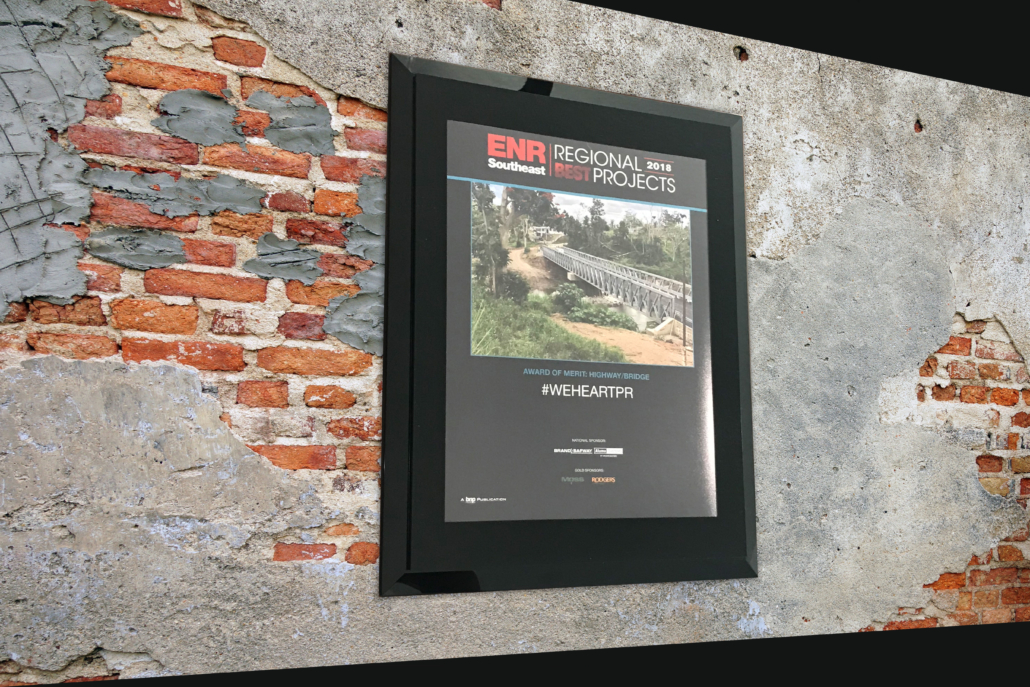
U.S. Bridge Wins Award of Merit at ENR Southeast Best Project Award 2018

The Engineering News-Record (ENR) provides news on engineering and construction for professionals in the construction industry. Each year they hold a competition that honors the regional best construction projects in the Southeast. This includes Alabama, Florida, Georgia, North Carolina, South Carolina, and Tennessee. With over ten different categories, the competition selects their winners and honorees based on the design and execution of each project. And last year, U.S. Bridge submitted the #WeHeartPR project for the Liberty Bridges provided to communities affected by Hurricane Maria.

ENR Award of Merit: #WeHeartPR

After the devastation caused by Hurricane Maria, U.S. Bridge built 5 Liberty Bridges in affected communities throughout Puerto Rico. U.S. Bridge manufactured and completed installation of the bridges within a six-week period.

The Liberty Bridge was the top choice because its quick assembly makes it ideal for emergencies, and it can be a permanent structure. To build the bridges, more than 850 metric tons of steel were used to create more than 950 ft of bridge. Additionally, the team worked around the clock over the holiday season to accomplish the task. The result was 5 Liberty Bridges in the following areas:

  • Utuado
  • San Lorenzo, Morovis
  • Moca
  • Juana Diaz
  • Coamo

These Liberty Bridges were specifically built to ensure durability and longevity.  

ENR Southeast Best Project Award 2018

U.S. Bridge’s Award of Merit was in the Highway/Bridge category. It is an honor to be selected as a Best Project winner. This project in Puerto Rico was an important one. It not only allowed U.S. Bridge to engineer and manufacture long lasting steel bridges, but also help those communities get back to normal.

The #WeHeartPR project was highlighted in the October 29th Best Projects issue of ENR Southeast. Then, it was celebrated at the Best Projects Awards luncheon November 1st at the Renaissance Orlando at Sea World.

ENR Award
The U.S. Bridge Prefabricated Steel Bridge Process

U.S. Bridge prides itself on working with the latest engineering techniques and the most advanced materials. Incorporating prefabricated steel bridges into stable products has enabled the company to expand. Also, this allows immediate help in areas where traffic patterns demand a quick fix. Below is an overview of the U.S. Bridge prefabricated steel bridge process and why these bridges are such a game-changer for infrastructure.

 Why Prefabricated?

Prefabricated steel bridges have transformed the bridge-building industry. They are a cost-effective solution to a critical need: reinforced and revamped bridges. Key features of these bridges are:

  • Easy Upkeep – All connections are bolted, eliminating pins that often require frequent maintenance. Galvanized steel is also a completely recyclable material and is abundantly available keeping costs down.
  • Easy Assembly – Fewer parts means putting the bridges together is a quicker process. Consequently, fewer parts significantly reduce the chance for on-site construction errors. This makes assembly quicker and increases quality assurance. For more information about accelerated bridge construction, click here.
  • Easy Disassembly –  It is easy to disassemble prefabricated steel bridges, making it convenient to use as temporary or emergency structures.

 Why U.S. Bridge?

These prefabricated bridges were first used in the 1930s. As an industry leader and trailblazer, U.S. Bridge has been building prefabricated steel bridges since 1936. As an AISC certified fabricator of Advanced Bridges with Fracture Critical and Sophisticated Paint Endorsements, U.S. Bridge has a proven and reliable fabricating and quality assurance process. U.S. Bridge’s Engineering to Fabricating interface program ensures that all design and fabricating details are transferred to computer controlled CNC automated equipment. This includes a CNC Plate Processor, Automated Beam Line, Saw and numerous Robotic Welders. And, this direct transfer ensures that the bridge you have approved is the exact same bridge that will be fabricated.

U.S. Bridge meets the ongoing needs of our customers with a commitment to providing the highest level of quality bridge solutions possible. Their goal is to continually achieve a “best practice approach” with everything they build. And, they have been doing it for more than 80 years.

For more information about U.S. Bridge and their Prefabricated Steel Bridge Process, please call +1 (888) 852-0094.

The Liberty Bridge: Connecting Communities In Puerto Rico

Created from prefabricated panels and assembled in modules, the Liberty Bridge is a proven type of structure offering profound benefits in flexibility and installation. These advantages went a long way toward helping Puerto Rico heal following the Hurricane Maria devastation.

Featuring 8-foot by 12-foot welded panels, the Liberty Series is unique in that it can be configured and installed quickly without special equipment. Made of new, domestic steel, the Liberty Bridge can be launched or set with the use of a crane. With all-bolted connections, the bridge functions without the need for pins or other proprietary parts or designs. And thanks to floor-to-truss framing connections engineered according to AASHTO LRFD Bridge Design Specification, the model offers superior stability.

Benefits of the Liberty Bridge

While the Liberty Series is created to serve as a high-quality, permanent structure, it’s also suitable for emergency or temporary bridging. If necessary, the structure can be easily unbolted and moved in sections to another location. Spanning up to 200 feet, the Liberty Bridge can support one or multiple lanes of traffic and comes with either checkered plate or anti-skid epoxy flooring. All of these features help make the Liberty Bridge an ideal choice for dealing with emergencies.

Helping Puerto Rico Heal

In 2017, Puerto Rico suffered a devastating natural disaster. A once-in-a-lifetime storm, Hurricane Maria featured 175-MPH winds and flooding and left all of Puerto Rico without power for weeks.

Additionally, the hurricane devastated the island’s infrastructure, destroying bridges in Utuado, San Lorenzo, and Juana Diaz, among other areas, leaving residents stranded and vulnerable. That’s where US Bridge came in.

A leader in bridge building and design, U.S. Bridge was proud to be able to help Puerto Rico residents recover from this difficult period in their lives. Within a mere six weeks, the company had manufactured and installed bridges in five communities across the island. The modular bridges helped bring relief to local families, connecting them with much-needed support and services.

Contact U.S. Bridge Today

Wondering if the Liberty Series Bridges are right for your needs? The Liberty Series Bridge has been load tested by the West Virginia University. Report available upon request.  Contact us for more information.