Rural Connectivity: How Bridges Support Local Economies | U.S. Bridge
In rural communities, a bridge is rarely just a way to cross a river or stream. It can be the route a farmer uses to move equipment and products, the road employees take to work, the connection families rely on to reach schools and healthcare, and the path emergency responders need when every minute matters.
When that connection becomes outdated, weight-restricted, or closed, the effects can extend well beyond the bridge itself. Longer detours increase transportation costs, businesses become harder to reach, freight movement can slow, and residents may lose convenient access to essential services.
That is why rural bridge infrastructure plays an important role in local economic development. By maintaining reliable connections between people, businesses, farms, services, and regional transportation networks, bridge investments can help rural communities remain competitive and connected.
For U.S. Bridge, headquartered in Cambridge, Ohio, that connection between bridge infrastructure and rural economic vitality is especially meaningful. For generations, the company has worked with counties, townships, municipalities, and other partners to build bridges that keep communities moving.
Why Are Bridges Important to Rural Economies?
Bridges support rural economies by providing reliable access to jobs, businesses, farms, healthcare, schools, emergency services, and regional markets. When a bridge is replaced or upgraded, it can reduce detours, improve freight movement, strengthen transportation reliability, and make it easier for people and goods to move throughout a region.
The U.S. Department of Transportation Rural Surface Transportation Grant Program recognizes that connection. The program supports infrastructure projects intended to increase rural connectivity, improve the safe and reliable movement of people and freight, generate regional economic growth, and improve quality of life.
For rural communities, these benefits can be particularly significant because alternative routes may be limited. Closing one crossing can turn what was once a short drive into a lengthy detour.
The economic effects can ripple throughout a community.
Keeping Farms and Rural Businesses Connected
Agriculture, manufacturing, forestry, construction, and other industries common in rural areas depend heavily on reliable transportation.
A bridge with weight restrictions may force trucks, farm machinery, or other heavy vehicles to take alternate routes. A closed bridge can increase mileage, fuel consumption, delivery times, and transportation costs.
Conversely, a modern bridge designed for current transportation needs can restore a more direct connection between rural businesses and the markets they serve.
Research and infrastructure organizations have repeatedly highlighted this broader effect. Bridges are critical links within transportation networks, helping connect rural economies with local and regional markets while expanding access to employment and essential services.
For a local farmer, that might mean a more efficient route for moving crops or equipment. For a manufacturer, it could mean more reliable freight access. For a small business, it can mean keeping customers connected instead of sending traffic miles out of the way.
The bridge itself may occupy only a small part of the transportation network, but its economic reach can extend much farther.
An Ohio Example: Connecting Marion and Wyandot Counties
The importance of rural bridge infrastructure can be seen close to home.
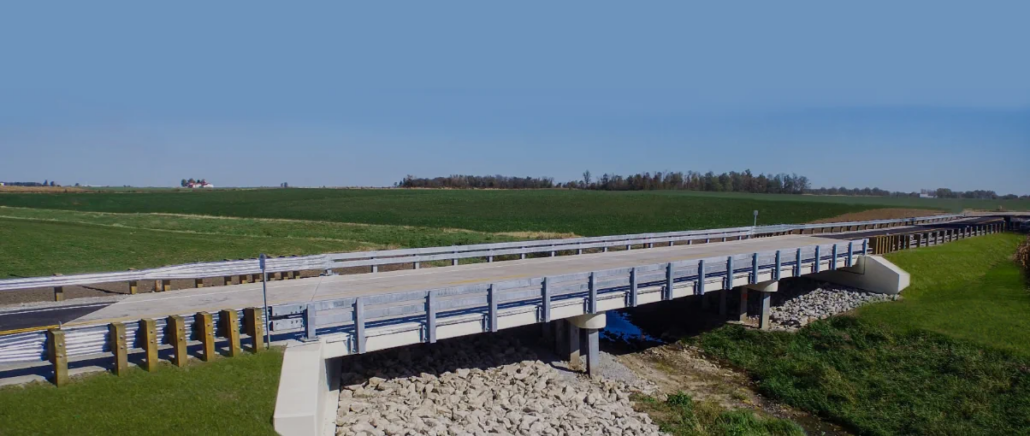
In 2021, U.S. Bridge designed, fabricated, and installed a new bridge connecting Marion and Wyandot Counties in Ohio. The crossing is located along a rural stretch of Route 68 spanning Salt Rock Township in Marion County and Pitt Township in Wyandot County.
The existing bridge over the Little Sandusky River provided a narrow crossing measuring approximately 70 feet long and just 15.3 feet wide.
The replacement modernized the crossing by increasing the span to 80 feet and widening the bridge to 24 feet.
For communities like these, bridge improvements are about more than dimensions on an engineering drawing. They help counties maintain the transportation networks residents, agricultural operations, businesses, and service providers depend on every day.
Reliable rural infrastructure creates the foundation for everything else that needs to move through a community.
Reducing the Economic Cost of Bridge Closures
Sometimes the economic value of a bridge becomes most obvious when the bridge is unavailable.
Closures and lengthy construction projects can create additional travel time, disrupt commercial activity, complicate freight routes, and make access more difficult for residents and emergency services. Temporary bridge solutions can help support business continuity and preserve important transportation connections while permanent infrastructure work moves forward.
Accelerated construction methods can also significantly reduce the amount of time a critical crossing is unavailable.
U.S. Bridge saw the importance of speed firsthand during a bridge replacement project in Muskingum County, Ohio.
Using a modular approach with steel tub girders and an SPS deck, bridge sections were fabricated off-site and the superstructure was set in approximately 20 minutes. From demolition of the existing bridge through construction of new abutments and the superstructure, the crossing reopened to traffic in just 26 days.
Accelerated bridge construction can be especially valuable in rural areas, where there may not be a convenient parallel route available. Every day a bridge remains closed can mean another day of longer trips for workers, deliveries, school transportation, emergency vehicles, and local businesses.
Bridges Expand Access to Opportunity
The economic importance of connectivity is not unique to Ohio—or even the United States.
Organizations working in isolated rural communities around the world have documented how dramatically access can change after a bridge is built.
Through its work in Rwanda, Bridges to Prosperity has helped connect rural populations that previously faced dangerous or unreliable river crossings. According to the Trafigura Foundation, bridges built in these communities have expanded access to markets, employment, education, and healthcare.
One resident of Rwanda’s Nyarusange community described how a new crossing created employment opportunities while also providing dependable access to farmland regardless of weather conditions.
The geography and scale may be different from rural Ohio, but the underlying principle is the same:
Reliable transportation creates access, and access creates opportunity.
How Prefabricated Steel Bridges Can Support Rural Infrastructure
Rural bridge projects often come with unique challenges. Counties and townships may have limited budgets, small project teams, constrained sites, difficult terrain, and a strong need to minimize road closures.
That makes prefabricated steel bridges particularly useful for many rural applications.
Much of the fabrication can be completed in a controlled manufacturing environment before bridge components arrive at the project site. This approach can simplify field construction and help reduce the amount of work that must occur at the crossing itself.
As we’ve explored in Why Use Prefabricated Bridge Construction?, prefabrication can offer important advantages when speed, quality control, and reduced on-site construction are priorities.
U.S. Bridge also outlines its approach in The U.S. Bridge Prefabricated Steel Bridge Process, from engineering and fabrication through delivery and installation.
Prefabricated truss bridges can be particularly well suited for challenging replacements over streams and railroads on low-volume roads. Depending on project conditions, they can help minimize the number of required substructures and address other construction challenges associated with rural sites.
U.S. Bridge’s Cambridge and Cambridge Flat bridge designs, for example, are engineered for applications that include rural environments.
For local governments, the goal is straightforward: create a durable crossing while restoring reliable access as efficiently as possible.
Building Bridges—and Economic Opportunity—in Ohio
U.S. Bridge’s connection to rural economic development extends beyond the bridges it manufactures.
U.S. Bridge was founded in Ohio in 1936, initially serving local governments, townships, counties, and small towns. Today, its headquarters and manufacturing operations remain in Cambridge, Ohio.
That Ohio footprint is growing.
As detailed in The People Behind the Steel: Spotlight on U.S. Bridge Workforce Expansion, U.S. Bridge’s major expansion in Guernsey County includes a new 70,000-square-foot facility dedicated to advanced welding and prefabricated production. The expansion is expected to create approximately 41 new full-time jobs and more than $2.3 million in new annual payroll.
That creates an economic cycle closely connected to infrastructure investment: Ohio workers manufacture bridges that support transportation networks in communities across the country, while continued investment in manufacturing creates additional jobs and economic activity at home.
It is another example of how infrastructure and economic development are closely linked.
Investing in the Connections Rural Communities Depend On
A bridge may connect two sides of a river, but its impact can connect much more.
It can connect a farmer to a market. A worker to a job. A student to a school. A patient to healthcare. A business to its customers. And a rural community to the broader economic opportunities around it.
That is why investing in rural bridge infrastructure is ultimately an investment in the people, businesses, and communities those bridges serve.
From rural county roads in Ohio to infrastructure projects across the country, U.S. Bridge continues to engineer and manufacture durable steel bridge solutions designed to keep communities connected.
When the right bridge is in the right place, the benefits extend far beyond the crossing itself.
Frequently Asked Questions About Rural Bridges and Local Economies
How do bridges help rural economies?
Bridges help rural economies by connecting residents and businesses to jobs, markets, schools, healthcare, emergency services, and regional transportation networks. Reliable crossings can reduce travel times and detours while supporting more efficient movement of agricultural products, freight, equipment, and people.
What happens economically when a rural bridge closes?
A rural bridge closure can increase travel distances, fuel costs, freight expenses, and travel times. It can also reduce convenient access to local businesses and complicate school transportation and emergency response, particularly when few alternative routes exist.
Why are prefabricated bridges useful in rural areas?
Prefabricated bridges can reduce the amount of fabrication and construction required at the project site because major components are produced in a controlled environment before delivery. This can help simplify installation and minimize disruption, which is particularly valuable on rural routes with limited detour options.
Does U.S. Bridge build bridges for rural communities?
Yes. U.S. Bridge engineers and manufactures multiple steel bridge systems suited for rural applications and has a long history of working with counties, municipalities, townships, and other public and private infrastructure partners.
Planning a rural bridge replacement or infrastructure project? Explore U.S. Bridge’s prefabricated steel bridge solutions or contact our team to discuss the needs of your community.