Why Prefabricated Bridges Are Powering the Future of U.S. Infrastructure

A New Era for Bridge Construction
Across the United States, infrastructure is undergoing a long-overdue transformation. With aging bridges, rising traffic demands, and increased public investment, the need for faster, safer, and more cost-effective construction methods has never been greater.
Recent industry and public-sector analysis reinforces the urgency. The ASCE 2021 Infrastructure Report Card points to the ongoing need to modernize aging bridge assets, while our last month’s article on federal and state funding for bridge projects explains how today’s funding environment is accelerating project demand and raising expectations around delivery speed.
Enter prefabricated bridge systems — a modern solution reshaping how bridges are designed, built, and delivered. As DOTs, municipalities, and contractors look for smarter ways to stretch infrastructure dollars, prefabrication is becoming a cornerstone of the next era of bridge delivery. For agencies seeking modern bridge solutions backed by fabrication experience, the shift is as much about execution as innovation.
What Are Prefabricated Bridges?
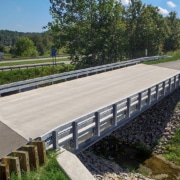
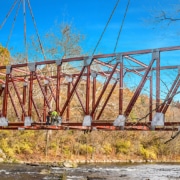
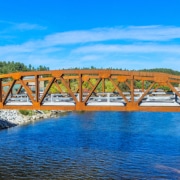
Prefabricated bridges — often called Prefabricated Bridge Elements and Systems (PBES)— use components manufactured off-site or near-site in controlled conditions, then transported and assembled in the field. FHWA says PBES helps reduce on-site construction time and the mobility impacts that come with building, replacing, or rehabilitating bridges through conventional methods.
This model aligns closely with the U.S. Bridge prefabricated steel bridge process, where fabrication efficiency, streamlined assembly, and repeatable manufacturing play a central role in project delivery.
Why the Shift to Prefabrication Is Accelerating
1. Faster Project Delivery
Time is one of the most valuable variables in infrastructure construction.
Traditional bridge construction can stretch for months or years, especially when weather, labor availability, and traffic maintenance complicate site work. Prefabrication shortens that timeline by allowing fabrication and site preparation to happen in parallel, reducing field labor and compressing installation windows.
FHWA’s Accelerated Bridge Construction program notes that agencies can sometimes replace bridges in as little as 48 to 72 hours and reduce planning and construction efforts by years, while also producing safer, more durable bridges.
That speed advantage is one reason owners and contractors continue turning to U.S. Bridge bridge systems and services designed to support efficient fabrication and erection.
2. Reduced Traffic Disruption
Traffic disruption is one of the biggest hidden costs in bridge replacement.
FHWA’s PBES guidance explains that using prefabricated elements minimizes construction-related traffic disruptions and shortens closure durations, allowing traffic patterns to return to normal more quickly.
That matters for commuters, freight movement, emergency access, and local economies. FHWA’s PBES decision-making framework puts it plainly: “time is money for all players.”
For project owners focused on minimizing downtime, our bridge kits and other modular-ready options can support faster on-site assembly and more predictable installation schedules.
3. Stronger Quality Control
One of prefabrication’s biggest strategic advantages is quality consistency.
When bridge elements are manufactured in a controlled environment, teams can better manage tolerances, material handling, sequencing, and inspection. FHWA’s PBES resources emphasize that off-site fabrication reduces on-site construction time while supporting more controlled construction processes.
U.S. Bridge reinforces that same value proposition in its recent post on the company’s prefab facility expansion, noting that factory-built bridge solutions improve precision, quality control, and schedule reliability.
4. Improved Safety
Prefabrication can also improve safety for both workers and the traveling public.
Shorter on-site durations mean fewer crews working in active traffic zones, fewer temporary conditions, and less exposure to common field risks. FHWA says ABC methods can reduce traffic delays and road closures while delivering safer, more durable bridges.
That safety benefit becomes even more valuable as bridge owners try to replace aging structures without prolonging disruptions or increasing risk to motorists and work crews.
Market Growth Is Supporting the Shift
The move toward prefabricated bridges is not just an operational trend — it is also backed by market growth.
One market analysis projects the global prefabricated bridges market to grow at a 6.6% CAGR, reaching $9.33 billion by 2032.
At the same time, U.S. infrastructure funding is creating a stronger demand environment for bridge replacement and modernization. U.S. Bridge’s recent funding article notes that the IIJA dedicates $40 billion over five years to bridge needs, helping create a multi-year runway for repair and replacement work.
Together, those two forces — rising market adoption and stronger public investment — are creating favorable conditions for fabricators and bridge manufacturers that can deliver quickly, consistently, and at scale.
The Bigger Picture: Modern Infrastructure Demands Modern Methods
Bridge owners today are under pressure to do more than just replace old assets. They are being asked to deliver resilient, durable infrastructure with less disruption, tighter schedules, and better lifecycle value.
That is exactly why prefabrication is gaining traction. It supports:
- Faster deployment
- Reduced traffic impacts
- Better quality control
- More predictable schedules
- Strong alignment with accelerated bridge construction strategies
FHWA and industry reporting both point in the same direction: modern bridge delivery is increasingly tied to off-site fabrication, modular construction, and accelerated installation methods.
How U.S. Bridge Is Positioned for the Future
As prefabrication becomes more central to bridge delivery, companies with proven fabrication capability and scalable systems are in a strong position.
U.S. Bridge’s current site reflects that positioning across multiple areas:
- A broad bridge catalog for different span and application needs
- Longstanding fabrication and field expertise through its services page
- A dedicated look at its prefabricated steel bridge process
- Recent insight into expansion of prefab capacity
- Related project and performance proof through case studies
- A relevant companion article on what federal and state bridge funding means for project delivery
That combination supports U.S. Bridge’s strategic fit in a market that increasingly values prefabrication, accelerated construction readiness, and schedule certainty.
The Bottom Line: Prefabrication Is the Future
Prefabricated bridges are no longer a niche delivery method. They are becoming a preferred strategy for meeting the demands of modern infrastructure.
With benefits that include faster delivery, reduced traffic disruption, stronger quality control, and improved safety — plus favorable market growth and sustained public investment — prefabrication is set to play a defining role in the future of U.S. bridge construction.
For owners, agencies, and contractors looking to move projects forward with greater speed and confidence, U.S. Bridge is ready to help. Get a quote today!