Tag Archive for: building material

How Hazardous Materials Transportation Affects Bridge Safety and Oversized Loads

Transporting hazardous materials (hazmat) from industrial chemicals to explosive cargo is vital to modern commerce but carries serious safety and regulatory obligations, especially when crossing major bridges and transportation infrastructure like those serviced by U.S. Bridge.

Hazardous materials are regulated at federal, state, and local levels to minimize risks to the public and infrastructure. Motor carriers must comply with the U.S. Department of Transportation’s Hazardous Materials Regulations (HMR) under 49 CFR Parts 171–180 and often obtain special permits or endorsements before moving such cargo on public highways or across bridges.

What Defines Hazardous Materials?

Hazardous materials include any substance that poses a risk to health, safety, or property during transportation. Under the Federal Motor Carrier Safety Administration (FMCSA) and the Pipeline and Hazardous Materials Safety Administration (PHMSA), carriers must ensure materials are correctly classified, packaged, labeled, and accompanied by appropriate shipping documents before movement.

Certain materials also trigger requirements for a Hazardous Materials Safety Permit (HMSP), such as:

  • Radioactive materials in highway route-controlled quantities
  • Large quantities of explosives (e.g., Division 1.1, 1.2, or 1.3)
  • Toxic inhalation hazards over specified limits

These permits demonstrate compliance and authority to transport highly hazardous goods.

Bridge and Route Restrictions for Hazmat

Many bridges in the United States have specific restrictions on transporting hazardous materials to protect structural and public safety. For example, the Port Authority of New York and New Jersey prohibits certain hazardous cargo on the upper level of the George Washington Bridge, such as USDOT Class 1 explosives, unless prior permission is granted and specified escort procedures are followed.

Similarly, state and local regulations may further limit hazmat transit. New York’s rules for bridges such as the Throgs Neck Bridge require advanced permission and schedule adherence when moving explosives over crossings.

Other facilities like the Chesapeake Bay Bridge-Tunnel (CBBT) explicitly forbid specific hazard classes — including certain explosive divisions and poisonous gases to reduce risk over long water crossings.

Local jurisdictions also stipulate time-of-day windows for hazmat transport through cities or over bridges to avoid peak congestion and minimize exposure to populated areas.

Permits and Escorts for Oversize and Hazmat Loads

In addition to hazmat regulations, transporting oversized or overweight loads often requires state or local permits, coordination with transportation authorities, and sometimes police or utility escorts. Oversized load requirements such as width, length, and height limitations vary by jurisdiction, and planned routes must consider bridge clearances and load capacity. 

For example, movement of oversized equipment near the George Washington Bridge approaches requires notice to relevant agencies to ensure safe crossing and compliance with restrictions on both hazardous and heavy freight.

Why These Rules Matter

Strict regulation of hazardous materials and oversized loads is essential to maintaining infrastructure integrity and public safety. Spills or incidents involving hazmat cargo on bridges can have catastrophic environmental and structural consequences. By enforcing permits, routing restrictions, and escort requirements, transportation authorities reduce risk and improve emergency preparedness.

How U.S. Bridge Fits Into this Framework

At U.S. Bridge, understanding these transportation requirements from federal hazardous materials regulations to local bridge restrictions informs planning and logistics for large-scale projects involving material delivery or construction staging. Projects involving heavy traffic, abnormal oversize components, or proximity to public roadways must consider permitting and routing to ensure both compliance and community safety.

Whether coordinating delivery of structural steel, modular bridge kits, or onsite construction equipment, early planning helps avoid delays and aligns with both state and federal hazmat transport regulations. 

Transporting hazardous materials across bridges is tightly regulated to protect people and infrastructure. Compliance with federal rules, plus awareness of local and bridge-specific restrictions, allows carriers and project planners to move goods efficiently while maintaining safety. For transportation and infrastructure partners like U.S. Bridge, integrating these regulatory considerations into project planning ensures safe, compliant, and successful outcomes.

Building the Best with U.S. Bridge


Whether making bridge repairs or constructing new structures, U.S. Bridge provides comprehensive and high-quality service that is friendly and time-efficient. As industry leaders and pioneers in several construction industry firsts, we know the importance of top-of-the-line materials, unique and reliable designs, and the industry’s top engineers.


Working with us means working with professionals at every stage of the process. Get in touch with us now to begin the process, or use our exclusive Bridgescope tool for a jumpstart.
Subcontractors play a key role in any construction project so it’s important that you hire a qualifying subcontractor that will ensure your project’s success. But how do you know what to ask or look for? Here’s a brief introduction to the role of a subcontractor and what should be included in the prequalification process.

What is a Bridge Subcontractor?

In every major bridge construction project, you’ll find a general contractor and subcontractors. The contractor is the manager of most bridge projects; they are essentially in charge of the overall coordination of the project. They’re hired by a municipality or other key stakeholders, and ensure that projects meet their approval.

Subcontractors on the other hand can range from a single person to a large company and are typically hired by the contractor. However, that doesn’t make them an employee of the general contractor as subcontractors are independent businesses. Contractors can hire subcontractors for different reasons such as performing construction tasks, supplying equipment or other materials, and more.

Why it’s so Important to Prequalify your Subcontractors

Prequalification is gathering information about interested subcontractors to assess their capability to complete the project. It’s an important part of the preconstruction phase. A well-thought-out prequalification process not only reduces liability and insurance claims but presents safer worksites and increases profit potential.

This process also ensures that you are selecting the best subcontractor for the needs of your project. Although a subcontractor may be a great choice for one project it does not guarantee that they’ll be the best choice for the next.

Even though this process may initially seem like a waste of time and resources, it actually saves your project from significant financial loss down the road.

What to Consider When Looking for a Qualifying Subcontractor?

When it comes to creating a thorough prequalifying process, it’s important to request information such as the subcontractor’s safety records, finances, litigation history, insurance coverage, relevant work history, and experience, etc.

Financial

Before hiring a subcontractor, you can request financial information such as current year revenues, total and current assets, net equity, current liabilities, average monthly billings, and if available their Dun & Bradstreet number. This will reveal any obvious red flags and help you avoid financial risks.

Litigation History

A company’s litigation history is important as it provides insight into their relationship with previous clients and how likely they are to breach a contract. Find out if they’ve ever had any labor law violations, if their license has ever been suspended or revoked, and if they’ve ever been terminated from a contract. Additionally, inquire if the company has had any judgments filed against them.

Safety Records

It is crucial that you carefully review the safety records of any potential subcontractor. Request information such as their OSHA 300 information, any citations issued, and their Experience Modification Rate for the past three years. Not only that but also implore about their training program and safety plans.

Ask for References

You’ll want to ask your potential subcontractors to provide a handful of references about– three to four. These references will demonstrate how well they collaborate with other contractors on projects as well as the quality and dependability of their work.

Qualifying subcontractors won’t have any issues providing contacts, and sometimes employees can also verify the company’s credibility.

Working with U.S. Bridge

When it comes to hiring contractors or subcontractors for your project, you want to make sure that you’re hiring the best. Our 80+ years working with various companies all across the world has provided us with the skills and experience needed for even the most challenging projects. At U.S. Bridge, we serve to meet the needs of our customers and the industry with high-quality bridges and materials.

Contact us on our website to learn more about how you can collaborate with us or fill out our exclusive BridgeScope tool for a quick quote.

With the sudden outburst of COVID-19 last year, many individuals were concerned about how it would affect the economy. Despite the negative effects of the pandemic, studies indicate a steady rise in the global bridge construction market.

Here’s a quick breakdown of the bridge construction market and what factors affect its growth.

The Construction Market

The construction market consists of sales made in the construction industry such as construction services and goods by organizations, sole traders, and partnerships that construct buildings or engineering projects (e.g., highways and utility systems). While the market primarily consists of the construction of buildings or other projects, it also includes the process and materials necessary for preparing new construction sites.

These materials are obtained from both domestic and international suppliers such as manufacturers and wholesale trade operators. The service and goods provided by this market include construction, civil engineering, specialty trade contracting, and other residential, non-residential, and engineering modes.

What Affects the Market?

A large market such as the construction market has several variables that come together to influence the industry. However, there are always key factors that contribute more than others.

The availability of raw materials, the technology for extracting and processing raw materials, government policies, and increased sustainability focus all greatly affect the construction market. A great example of this is demonstrated through the pandemic as many companies struggled to procure their materials from their usual international suppliers. COVID-19 created a significant impact on the industry that will greatly affect but not hamper the market moving forward.

Technology is an important factor that is pushing change in nearly every industry. Its influence over the construction industry is illustrated with more drone usage and 3D printing than ever before. Not to mention, new innovative methods of bridge construction such as modular and prefabricated designs.

The Projected Global Boom of the Bridge Construction Market

In 2019, the global bridge construction market was valued at $908.0 billion and projected to reach $1,212.6 billion by 2027. Thus registering a CAGR of 4.6% from 2020 to 2027.  The strong growth of this market is attributed to an increase in investments, government initiatives, and global economic growth.

The global urban population is expected to rise by 2050. Thus, fueling the demand for bridge construction and other transport infrastructure. Furthermore, the surge in the standard of living, particularly in developing countries is anticipated to drive market growth.

In addition, technological advancements are expected to encourage the growth of the market. These improvements in equipment and systems are intended to reduce the time and cost involved in bridge construction. This economic and urbanization boom is expected to fuel the expansion of the railway networks throughout the globe. Thus boosting the growth of the bridge construction market.

U.S. Bridge

Here at U.S. Bridge, we pride ourselves as leaders in the bridge construction industry. We’ve been engineering and manufacturing bridges for decades with services worldwide.

We understand that a bridge project is a major investment. That’s why we designed an effortless process for you to build a bridge that will last generations. Please contact us for a free quote or use our exclusive bridge design tool Bridge Scope for a quick five-minute scope. Together, we’ll build a better future for America’s infrastructure.

Hot Dip Galvanized Steel Vs. Weathering Steel What's The Right Choice

Steel has long played a key role in American construction efforts. Not only is steel lighter in weight than many other building materials on the market, but it also earns points for durability, affordability, and environmental friendliness. Still, bridge builders may struggle with whether to use more traditional weathering steel or increasingly popular hot-dip galvanized steel. Read on to discover how these options stack up.Hot Dip Galvanized Steel Vs. Weathering Steel What's The Right Choice

Benefits and Drawbacks of Weathering Steel

Long a favorite among bridge builders, weathering steel offers numerous advantages over other building types. Strong and attractive, this material rusts in a way that provides protection against the elements. Builders refer to this as “useful corrosion.”

Still, the news about weathering steel isn’t all positive. Progressively corroding, weathering steel can deteriorate faster if moisture is present. To compensate for this loss of mass and strength, builders may need to use thicker sections of steel from the start. Additionally, salt air and humidity can damage weathering steel, resulting in accelerated corrosion.

Benefits of Hot-Dipped Galvanized Steel

Formed by dipping bare steel in molten zinc, hot-dip galvanized steel is a popular choice in bridge construction. Featuring the strength of weathering steel, hot-dip galvanized steel offers additional benefits, too. Barrier and cathodic protection mean that this material resists corrosion. As a result, this option requires less long-term maintenance than weathering steel. Additionally, hot-dip galvanized steel maintains its structure despite exposure to UV rays, snow, water, and soil and is 100 percent recyclable.

Trust U.S. Bridge With All Your Building Needs

As a bridge building leader, U.S. Bridge brings more than 80 years of engineering and manufacturing expertise to the table. We’re passionate about constructing bridges that withstand time and the elements while making use of materials that are safe for the environment. Ready to learn more about our products and services? Call our steel bridge experts today or contact us online for info.


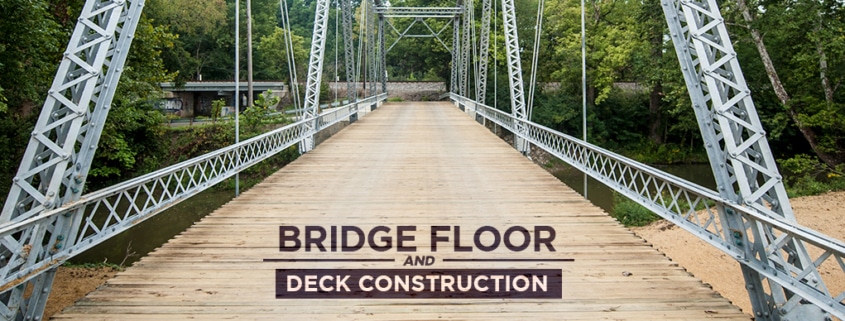
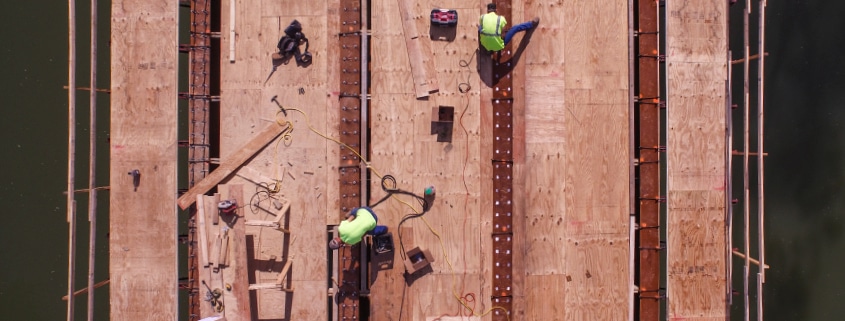
Those who aren’t familiar with bridge building might think of decks as parts of a ship or the area in the backyard where grills are kept. However, in the industry, we know “deck” is a term for the driving surface of a bridge. Whether constructed from concrete, wood, steel, or open grating, decks that form the driving surface of a bridge need to be strong enough for traffic to cross safely. At U.S. Bridge, we provide a full range of sustainable bridge floor and deck solutions to clients throughout the world. Read on to learn more about the types of decks we offer:

Concrete Deck Slab

When it comes to bridge floor and deck products, the concrete deck slab is one of the most popular. Typically between 7 and 9 inches thick, this deck has two layers of steel reinforcing bars to provide strength and durability.

Asphalt

For this deck type, corrugated steel planks, 3, 5 or 7 gauge, are attached to the stringers of the bridge and become a structural component of the structure.. By galvanizing these planks, the flooring is protected against corrosion. With an asphalt overlay, these types of decks provide a long-lasting, economical, driving surface.

Open Grid Steel Deck

If weight constraints are an issue, open grid steel decking is a wonderful option for a bridge floor. It is characterized by whether the grid is filled, or partially-filled with concrete. If concrete is included, a metal pan or form is included near the base or at mid-height of the grid to support the concrete while it cures.

Precast Concrete Panels

One of the most efficient deck types, precast concrete panels can be constructed quickly and easily. Designed and manufactured off site, these panels can be installed one day and driven over the next. Non-shrink grout is mixed and poured in batches on site.

Nail-Laminated Timber Bridge Floor

Ideal for more rustic locations around the country, these timber decks utilize pressure treated lumber to protect against the elements. Additionally, buyers can opt to cover the deck with asphalt if they choose.

Start Building Your Bridge Today

As a leader in bridge floor and bridge flooring solutions, U.S. Bridge engineers and manufactures steel bridges for a wide range of private and public organizations. You can trust us to create a safe, durable bridge that will stand the test of time. To learn more about what we do, call today or contact us for an online bridge consultation.

Analyzing the life cycle costs of steel vs. concrete bridges is of utmost importance to U.S. Bridge and the infrastructure industry in general. Aside from sustainability and social responsibility, U.S. Bridge is dedicated to using the best materials for the job. Depending on the scope of work and bridge design, the choice between steel or concrete could have a long-lasting impact on the sustainability of the structure.

U.S. Bridge asked Michael G. Barker Ph.D., a professor at the University of Wyoming, to draft a white paper regarding the Life Cycle Costs Analysis (LCCA) of bridges. Of particular interest was the use of hot-dip galvanized steel vs. concrete. The study determined that using HDG steel reduces capital costs by 8.5 percent. Below is the executive summary of the report that provides a good snapshot of the report and its findings. You can download the entire white paper here.

Executive Summary

Since the early 1990s, the Federal Highway Administration (FHWA) has promoted the consideration of Life Cycle Costs Analysis (LCCA) in the design and engineering of bridges. LCCA determines the “true cost” of bridge alternatives considering the time-value of money. The Life Cycle Cost analyses employed in this study uses the Perpetual Present Value Cost (PPVC) of bridge alternatives for an equivalent comparison between the alternatives.

Over the years, the author has worked with state departments of transportation and local county engineers on effective and economical bridge construction. A frequent question that arises during meetings is the difference in Life Cycle Costs between steel and concrete girder bridges. Both the concrete industry and the steel industry cite various anecdotal advantages above the other for the Life Cycle Costs over the life of the bridge. There has historically been a healthy competition between material types for new bridge construction. However, there is industry and owner confusion on how the different types of bridges compare on a Life Cycle Cost basis.

Steel vs. Concrete Bridge Analysis

This study developed useful owner information on historical Life Cycle Costs for typical steel and concrete state bridges in Pennsylvania. Typical bridges defined in the study are:

  • Concrete decks supported by steel rolled beams
  • Steel plate girders
  • Precast concrete boxes
  • Precast concrete beams

PennDOT historical records for bridges built between 1960 and 2010 were used to develop the Life Cycle Cost study database. Initial and maintenance costs considered include total project costs (more than just superstructure) as recorded in the PennDOT records. The PennDOT database used for the Life Cycle Cost analyses only includes a subset of the total bridge inventory. Missing cost and date data for a majority of the individual bridges made total inventory impossible. The database consists of 1,186 state bridges out of 6,587 (18 percent of the eligible inventory) built between 1960 and 2010.

The initial costs, Life Cycle Costs, and future costs of the 1,186 bridges in the database are examined with respect to:

  • Variability in bridge type
  • Bridge length
  • Number of spans
  • Bridge life

Protective coating systems were also used to examine steel bridges. The results must be taken into context since the results only represent the bridges that made it into the database. The database is not as comprehensive or desirable for drawing conclusions. The reader must decide how to interpret the tables and figures showing comparisons of initial costs, Perpetual Present Value Costs, maintenance and future costs, and bridge life.  

Report Conclusion Summary

A conclusion that can be drawn is that all the types of bridges are fairly competitive in both Initial Costs and Perpetual Present Value Costs. The average initial costs vary from $174 per square feet to $226 square feet. The average Perpetual Present Value Costs vary between $218 per square feet (Prestressed I Beam) and $278 per square feet (Prestressed Adjacent Box). The lowest average bridge life was 73 years (Prestressed I Beam) and the longest was 82 years (Steel I Beam). The coefficient of variation (standard deviation/mean) of the PPVC was approximately 20 percent, which is considerably high. With the relatively small differences in the PPVC averages, given the dispersion of the PPVC costs (standard deviation), any of the bridge types may have the least Perpetual Present Value Cost for a given project.

Chance for Further Study

This research was limited to a subset of PennDOT bridges. However, the analyses demonstrate the potential benefits of LCC analysis for bridge construction and management. A study of a more comprehensive database of bridges on the initial costs, Life Cycle Costs and future costs of different types of bridges over a diverse set of circumstances would be very useful for bridge owners and managers. A more comprehensive database would allow for a more accurate comparison of bridge types, design details, such as jointless decks, rebar coatings, steel protection systems, and other construction details.

For more information about this study, as well as the benefits of steel vs. concrete bridges, please contact U.S. Bridge today. You can also download the complete white paper here.